
Standing Up for Yourself as a Woman in Healthcare
There are moments that most women in healthcare can recall with startling clarity.
It’s the meeting where you realize your idea was accepted only after someone else repeated it. The contract negotiation where “this is just how it’s done” is used to shut down fair questions. The patient interaction where you’re mistaken for a nurse, assistant, or trainee - again, or you’re addressed as “honey”, “sweetheart”, or some unwanted descriptor of your looks. Or the quiet, sinking feeling that advocating for yourself might brand you as “difficult,” while staying silent slowly erodes your well-being.
Standing up for yourself in healthcare is not a personality trait. It is a skill - one that women are often discouraged from developing, even as the system quietly depends on their labor, empathy, and resilience.
For women physicians, advanced practice providers, dentists, nurses, and healthcare leaders, self-advocacy is not about being confrontational. It’s about occupying the space you’ve earned - and refusing to shrink to make others more comfortable.
Why Self-Advocacy Is Harder for Women in Healthcare
Healthcare remains deeply hierarchical and historically male-dominated, particularly in leadership and procedural specialties. While more women are entering the field than ever before, the structures themselves haven’t fully caught up.
Women are still more likely to:
Be evaluated on “likeability” rather than leadership
Receive vague feedback instead of clear advancement pathways
Take on invisible labor-mentorship, extra coverage, emotional work, administrative tasks
Face penalties for behavior that is praised in male colleagues
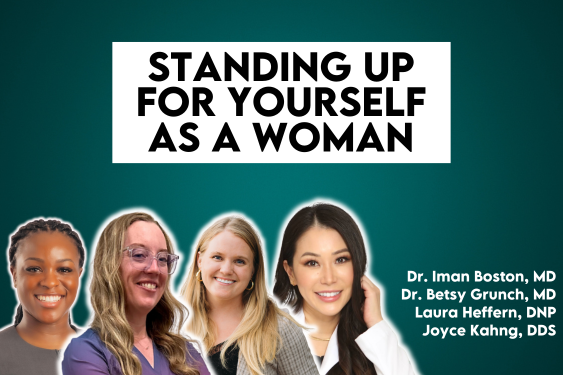
As Dr. Joyce Kahng has shared from her experience in dentistry:
“The way that it’s always been done traditionally isn’t necessarily built to support women.”
For women who want families, leadership, autonomy, or sustainability, following the traditional path often leads to burnout rather than fulfillment.
Self-advocacy, then, becomes less about ego and more about survival.
Speaking Up Isn’t Just for You
One of the most powerful - and underappreciated - aspects of standing up for yourself is that it rarely benefits only you.
Dr. Iman Boston speaking on the Pinnacle Podcast, put it simply:
“I think you should speak up for yourself. And I think sometimes when you speak up for yourself, you end up inadvertently speaking up for other people, too, that had the same thought that maybe just didn’t say it.”
Many inequities in healthcare persist not because people agree with them, but because they go unchallenged. When someone finally says, “I don’t think this is fair,” or “We need to talk about this,” it often opens the door for others who have been silently carrying the same concerns, who may not be in a position to enact the change themselves.
Self-advocacy is often collective advocacy in disguise.
The Myth of the ‘Nice’ Woman Leader
Women in healthcare are frequently taught - explicitly or implicitly - that being direct or demanding is risky. That addressing conflict head-on could damage relationships or reputations.
Dr. Betsy Grunch addressed this directly at a recent conference:
“We as women really have a hard time with being direct. We don’t want to be that person… but if you notice any type of toxic behavior, you need to address that.”
Avoiding conflict doesn’t prevent harm - it often allows it to spread. And indirect communication can backfire, especially in clinical and leadership environments where clarity matters. Things can get lost in translation if you are not direct, leading to worsening of situations, unnecessary interventions on unrelated subject matters, wasted resources, or even hurt feelings.
Directness does not have to mean harshness. It means:
Speaking to the person involved, not around them - passive aggression is not leadership, and involving others can lead to the propagation of issues
Addressing issues early, before bad habits or resentment builds - both for your sake and the other parties involved
Using facts and boundaries rather than apologies - you do not have to be sorry for doing your job
Being clear is not being cruel. It is being professional.
Self-Advocacy Across the Career Spectrum
Standing up for yourself looks different depending on where you are in your career - but it matters at every stage.
Trainees and Early-Career Clinicians
For residents, fellows, and new graduates, the power imbalance is real. Fear of retaliation or being labeled “problematic” can be paralyzing. Further, finding yourself in a position of power amongst your peers, like when becoming a nurse manager, chief resident, fellow, or attending can also lead to a shift in relationships in which boundaries can be hard to balance.
Yet, these are also the years when patterns are set - around workload, boundaries, and self-worth.
Advocacy here might mean:
Asking for clear expectations and feedback
Documenting concerns rather than relying on verbal assurances
Seeking mentors outside your direct reporting structure
Reddit threads from trainees are filled with warnings about the risks of speaking up - but also stories of regret from those who never did.
Mid-Career and Leadership Roles
With seniority often comes more leverage - but also more responsibility.
Women leaders frequently face the double bind of being expected to fix broken systems without being given the authority to change them.
This is where advocacy expands beyond personal needs to structural change: equitable schedules, transparent pay, parental leave policies, and inclusive leadership practices.
As Dr. Kahng noted, sometimes the answer isn’t forcing yourself into a system - it’s rebuilding it.
When Self-Advocacy Is Met With Resistance
Not every attempt to stand up for yourself will be met with understanding. Sometimes, it’s met with resistance, or worse, punishment.
Laura Heffern’s experience as a nurse practitioner highlights this reality. While pregnant and requesting minor accommodations, she was met not with support - but with the threat of discipline.
“The response I got was essentially you need to have a discipline meeting… I packed up my stuff from my desk that day and I walked out.”
Her story is painful - but familiar. And it underscores an uncomfortable truth: self-advocacy sometimes reveals environments that were never safe to begin with.
Leaving is not failure. Sometimes, it is the clearest form of self-respect.
Self-Advocacy and Burnout Are Deeply Linked
Burnout isn’t just about long hours. It’s about lack of control, lack of voice, and moral distress.
When clinicians repeatedly silence themselves - to keep the peace, to avoid conflict, to be unproblematic, to meet impossible expectations - the cost accumulates.
Advocating for yourself is not indulgent. It is protective.
This includes:
Negotiating contracts that reflect your value and that set firm boundaries of what work is and is not your responsibility
Saying no to uncompensated labor
Setting limits around availability and emotional bandwidth
Healthcare needs women who stay - not women who disappear quietly after giving everything they had.
Advocating for Yourself and Your Patients
For many women in healthcare, the line between self-advocacy and patient advocacy is thin.
Standing up to unsafe staffing, unreasonable productivity demands, or discriminatory policies often protects patients as much as clinicians. Healthy clinicians can help patients, overworked, under-appreciated clinicians cannot help others if they cannot help themselves.
Ethical care requires clinicians who feel safe to speak. You cannot create a safe space for a patient if you yourself do not feel safe in your environment.
And systems that punish advocacy - whether personal or patient-centered - are systems in need of reform or are not worth your energy.
Taking Up the Space You’ve Earned
Standing up for yourself doesn’t require becoming someone else. It doesn’t require abandoning empathy or collaboration.
It requires believing deeply that your voice belongs in the room.
That belief is not arrogance. It is earned.
Women in healthcare don’t need permission to advocate for themselves. They need practice, support, and systems that stop mistaking silence for professionalism.
When women take up space, healthcare becomes safer, more equitable, and more sustainable -for everyone.
And that is something worth standing up for.